


Il profondo legame che unisce Roma e l’antico Egitto ha una storia millenaria complessa, iniziata in epoca tolemaica e testimoniata dai numerosi obelischi tuttora presenti nella Città Eterna. I primi rapporti diplomatici tra le due civiltà risalgono al 273 a.C., anno di stipula del trattato d’amicizia tra la Repubblica Romana e il faraone Tolomeo II Filadelfo – secondo sovrano della dinastia greco-macedone fondata nel 305 a.C. dal generale di Alessandro Magno Tolomeo I Sotere ed estintasi nel 30 a.C. con la morte di Cleopatra VII – che pose le basi della futura influenza romana sul regno.

L’iniziale rapporto diplomatico tra pari si trasformò progressivamente, nel corso di due secoli, in un protettorato informale di Roma, culminato nell’annessione dell’Egitto in seguito alla sconfitta, operata da Ottaviano, di Marco Antonio e Cleopatra ad Azio e del suicidio di quest’ultima. In seguito alla divisione dell’Impero Romano operata dopo la morte di Costantino, il paese divenne parte dell’Impero Romano d’Oriente e, successivamente, dell’Impero Bizantino fino alla conquista araba avvenuta nel 641 d.C.

Inaugurata lo scorso 3 luglio e aperta al pubblico fino al 15 novembre 2026 nell’Aula Ottagona delle Terme di Diocleziano (Museo Nazionale Romano), la mostra “Aegyptus – Dal Nilo al Mediterraneo. Oasi e deserto in epoca romana” racconta un Egitto diverso da quello consolidato nell’immaginario collettivo. Il progetto, ideato da Elisabetta Bruscolini e curato da Alfonsina Russo, Angelo Piero Cappello, Federica Rinaldi e Alessio De Cristofaro nell’ambito delle attività di cooperazione culturale tra l’Italia, l’Africa e il Mediterraneo, riflette infatti il periodo iniziato con la conquista dell’Egitto ad opera di Ottaviano e terminato con l’avvento del cristianesimo e della cultura copta.

L’esposizione multimediale è organizzata in tre aree tematiche che fondono archeologia, videoarte e intelligenza artificiale: reperti provenienti dai depositi del Museo Nazionale Romano, frutto dell’attività di recupero del Comando Carabinieri per la Tutela del Patrimonio Culturale (“Carabinieri TPC”, noti anche come “Carabinieri dell’Arte”) e filmati dedicati all’influenza romana in Egitto in forma di opere ingegneristiche, quali fortezze e acquedotti, finalizzate a facilitare le vie carovaniere e, con esse, gli scambi commerciali. Un Egitto Romano illustrato da reperti e immagini che testimoniano una forte compenetrazione tra le due culture destinata a durare nel tempo.

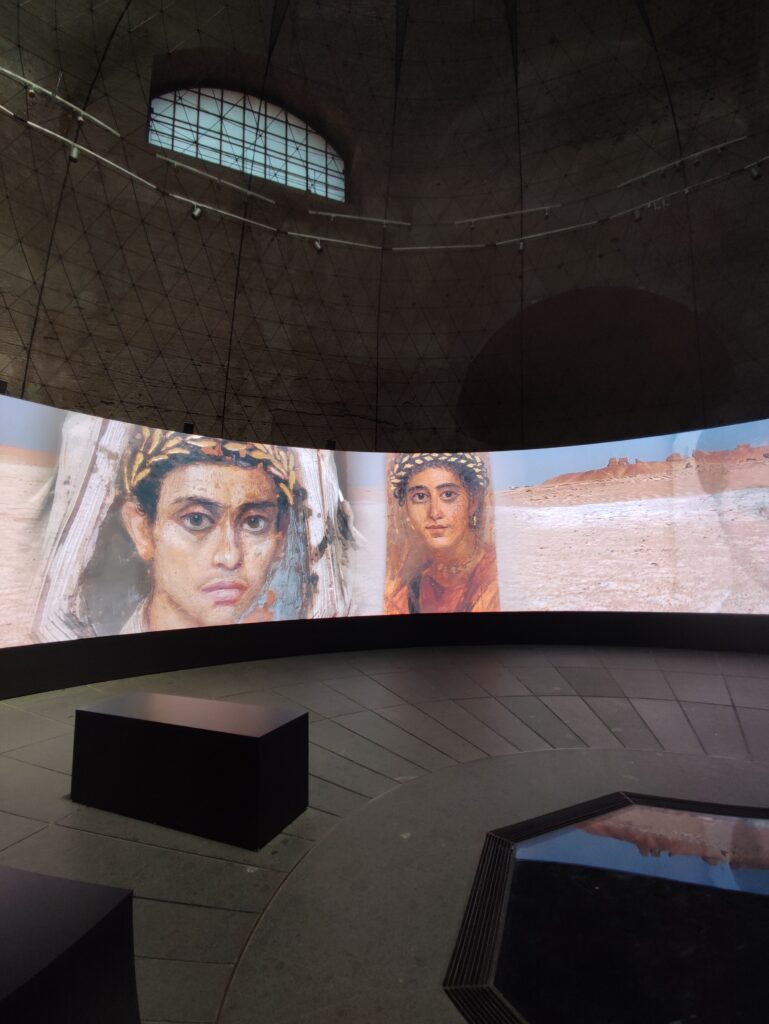
La mostra si avvale di un’installazione avveniristica concepita come un percorso a spirale, realizzato dallo studio VPS Architetti, che si snoda all’interno della magnifica Aula Ottagona delle Terme di Diocleziano, affiancando una sezione espositiva di impianto tradizionale ad un’area multimediale racchiusa da uno schermo curvo di enormi proporzioni attraverso il quale un’opera di video-arte realizzata dallo Studio Covertino e un filmato creato da Riccardo Bozzi con l’utilizzo dell’intelligenza artificiale avvolgono il visitatore in una proiezione immersiva.

Nota anche come Museo dell’Arte Salvata, l’Aula Ottagona ospita a rotazione reperti e opere d’arte recuperati dallo Stato Italiano in Italia e all’estero attraverso l’incessante lavoro del Comando Carabinieri per la Tutela del Patrimonio Culturale. Prima unità di polizia al mondo specializzata nella tutela dei beni culturali, il reparto venne fondato il 3 luglio 1969 su iniziativa dell’allora Capo di Stato Maggiore protempore Generale Arnaldo Ferrara con la denominazione Nucleo Tutela Patrimonio Artistico, un’intuizione che anticipò di circa un anno la raccomandazione della Conferenza UNESCO del 1970 relativa all’istituzione, presso ciascuno stato membro, di forze di polizia preposte alla lotta contro il traffico illecito di beni culturali. Il 20 settembre 1971 il reparto venne elevato al rango di Comando di Corpo, retto da un Colonnello avente alle dipendenze il preesistente Nucleo Tutela Patrimonio Artistico, successivamente riconfigurato come reparto operativo. Con Decreto del Ministro per i Beni Culturali e Ambientali del 5 marzo 1992, il Comando venne formalmente collocato nell’ambito del Dicastero e ribattezzato Comando Carabinieri per la Tutela del Patrimonio Artistico, denominazione mantenuta fino al 2001, quando assunse quella attuale di Comando Carabinieri per la Tutela del Patrimonio Culturale.


Numerosi i reperti egizi recuperati dai Carabinieri TPC ed esposti nell’ambito della mostra. Bassorilievi, statue, tessuti, amuleti e manufatti di varia natura, anche di apparente produzione moderna, recuperati attraverso sequestri e restituzioni spontanee in territorio italiano ed estero.


Tra i recuperi di maggior rilievo, una rara urna cineraria in alabastro cotognino, due splendidi frammenti di statue in basalto provenienti dal Metropolitan Museum of Art di New York (Met), una tavolozza predinastica teriomorfa per cosmetici e un amuleto in forma di stele raffigurante il dio Horo fanciullo. Risalente al I secolo d.C. e sottratta illegalmente da un complesso funerario ubicato in località Sassone-Castellano sul finire degli anni Settanta del Novecento, l’urna cineraria, nota come “Urna di Ciampino” è stata tempestivamente sequestrata dai Carabinieri TPC su segnalazione di una casa d’aste dopo essere apparsa sul mercato antiquario nel maggio 2021. L’azione congiunta del Comando e della Soprintendenza Archeologia Belle Arti e Paesaggio per l’area metropolitana di Roma e per la provincia di Rieti ha, in seguito, consentito di rinvenire in loco la base mancante dell’urna, caratterizzata da un corpo stretto e allungato e della cui tipologia sono noti solo nove esemplari.
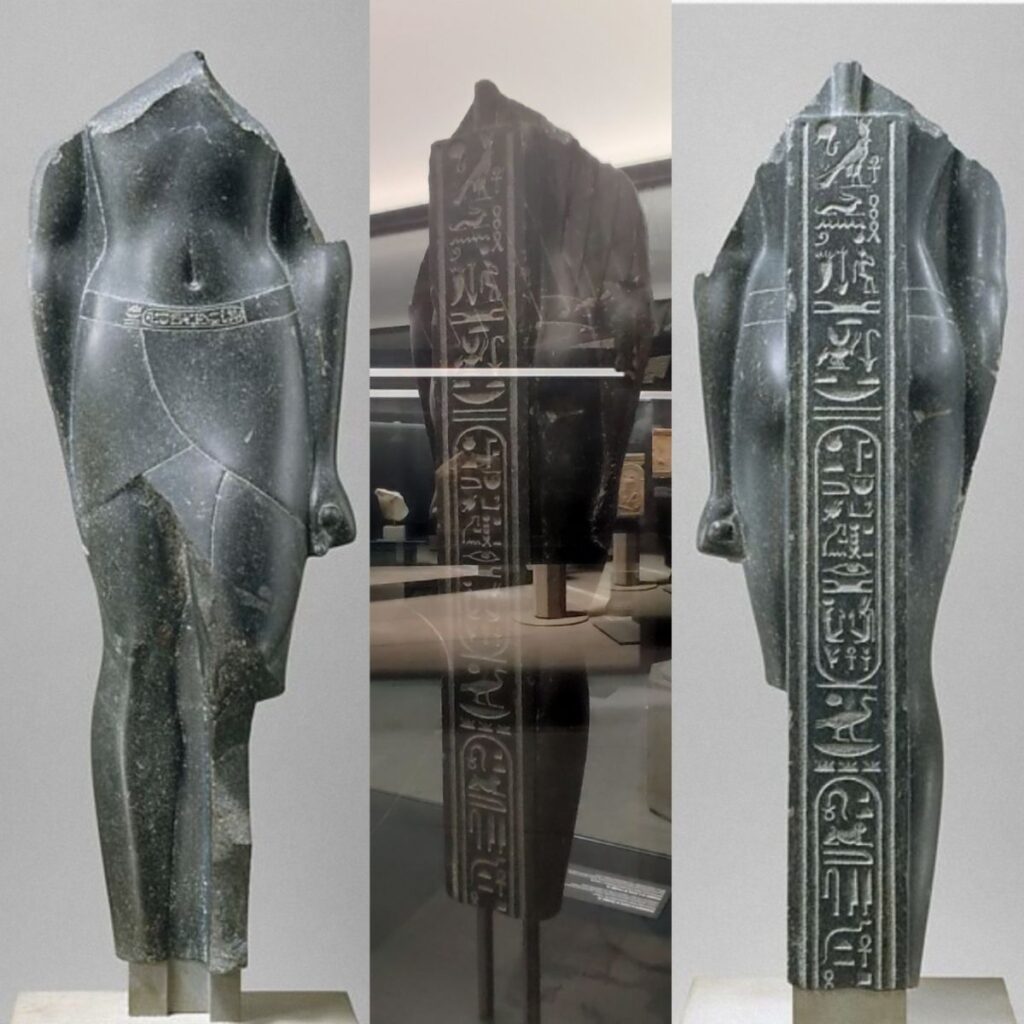
Torso of a Ptolemaic King, inscribed with cartouches of a late Ptolemy, Ptolemaic Period 80-30 B.C. Formerly in the collection of the Metropolitan Museum of Art, New York, repatriated to Italy in 2025. Composite Image: © Mirta Aktaia Fava; central photograph shot on site © Mirta Aktaia Fava; lateral photographs from The Met website

Torso of a King, Ptolemaic Period, 332 – 30 B.C., formerly in the collection of the Metropolitan Museum of Art, New York,, repatriated to Italy in 2025. Image: © Mirta Aktaia Fava
Magnifici i due torsi di re in basalto provenienti dal Metropolitan Museum of Art di New York, rimpatriati in Italia nel 2025 insieme ad altri dodici reperti in seguito ad un riesame della loro provenienza effettuato dal Museo americano nell’ambito della sua recente “Cultural Property Initiative”. Le due statue, ritenute “di fattura egizia e probabilmente portate in Italia durante l’occupazione romana dell’Egitto” presentavano provenienza dubbia, essendo state acquistate dal Met dal mercante d’arte americano Peter Sharrer nel 198, ma precedentemente di proprietà del controverso antiquario britannico Robin Symes e del trafficante d’arte e di antichità Giacomo Medici.

Tra i recuperi esibiti nelle teche di “Aegyptus” rientra una tavolozza da cosmesi predinastica teriomorfa, ovvero a forma di uccello, risalente alla seconda fase dell’epoca Naqada (circa 3700-3400 a.C.), sequestrata dai Carabinieri TPC nel settembre 2022 nell’ambito dell’operazione Pandora VII. L’operazione ha rappresentato uno dei primi interventi eseguiti in applicazione dell’allora nuovo reato d’importazione illecita di Beni Culturali (art. 518 decies c.p.), introdotto nell’ordinamento italiano dalla Legge n. 22 del 9 marzo 2022 in ottemperanza al Regolamento UE 880/2019 e alla Convenzione di Nicosia. Ipnotico il piccolo amuleto in basalto noto come “Stele di Horo sui Coccodrilli”, risalente alla Tarda Epoca Egizia (378 a.C., XXX Dinastia) e raffigurante il dio Horo fanciullo immerso in simbolismo apotropaico associato al pericolo: il giovane dio stringe infatti in entrambe le mani serpenti e scorpioni mentre cammina su due coccodrilli; alle sue spalle sono presenti la maschera del dio Bes, affiancata a destra dal dio della guerra e della caccia Onuri e a sinistra dalla divinità guaritrice Selkis. Emerso durante scavi archeologici condotti in Calabria sul finire degli anni Settanta del Novecento nella città di Crotone, e successivamente scomparso, il reperto venne sequestrato dal Carabinieri TPC al Museo del Castello Sforzesco di Milano nel 2011 e restituito alla città di origine nel 2012. Fondamentali per il ritrovamento presso il museo milanese, dove era esposto all’interno della Civica Raccolta Egizia e catalogato come oggetto di provenienza ignota, le indagini condotte dall’architetto Tommaso Tedesco, allora ispettore onorario della Soprintendenza della Calabria. La Stele di Horo è esposta presso il Museo Archeologico Nazionale di Crotone con il numero di inventario 7816/M.


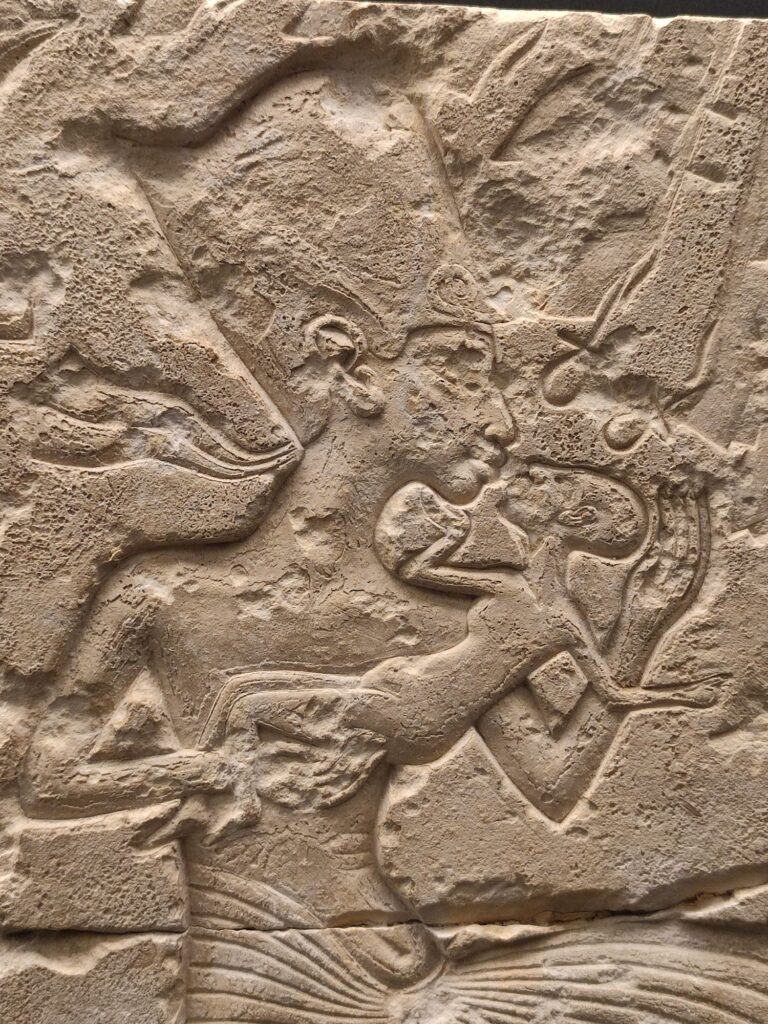
A testimonianza della varietà dei recuperi effettuati dai Carabinieri TPC, la mostra “Aegyptus” include un’interessante sezione dedicata ai falsi moderni. Tra questi spiccano uno splendido busto femminile, i cui tratti somatici anomali, la tecnica di scultura e il tipo di materiale lapidario utilizzati sembrano tuttavia indicare una produzione relativamente recente, e un bassorilievo raffigurante il faraone monoteista Akhenaton ispirato ad una stele conservata presso il Neues Museum di Berlino.


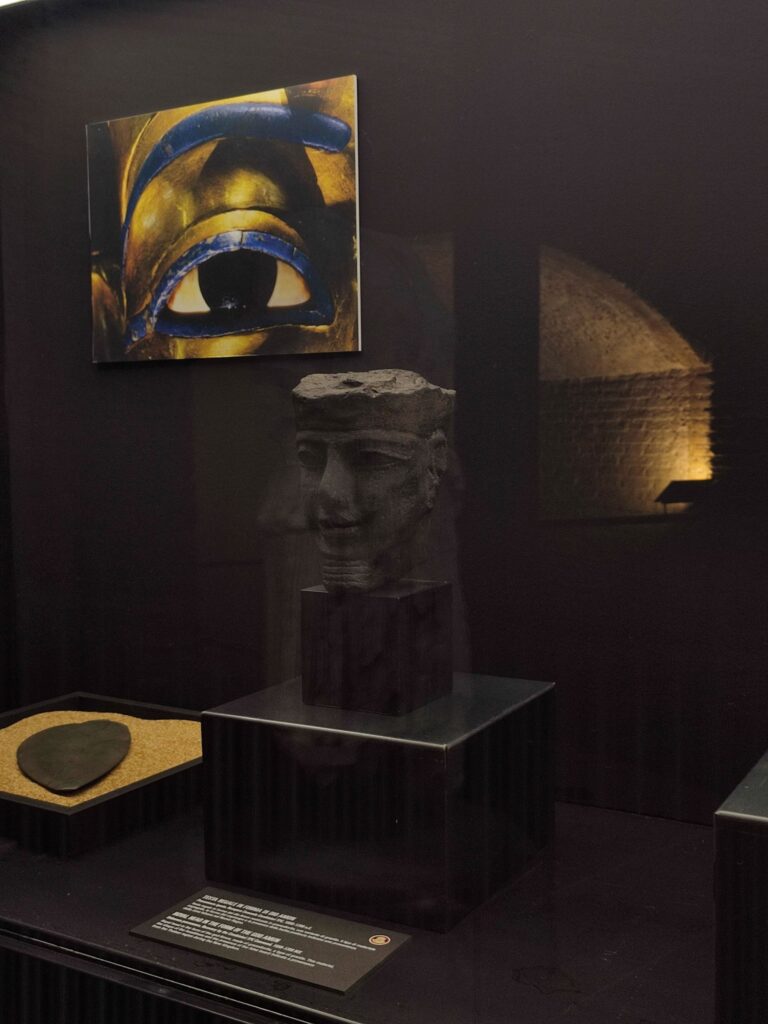
Una testa di Apollo di stanza nell’Aula Ottagona delle Terme di Diocleziano osserva una Stele di Iside Thermutys, II secolo d.C., proveniente dai depositi del Museo Nazionale Romano.
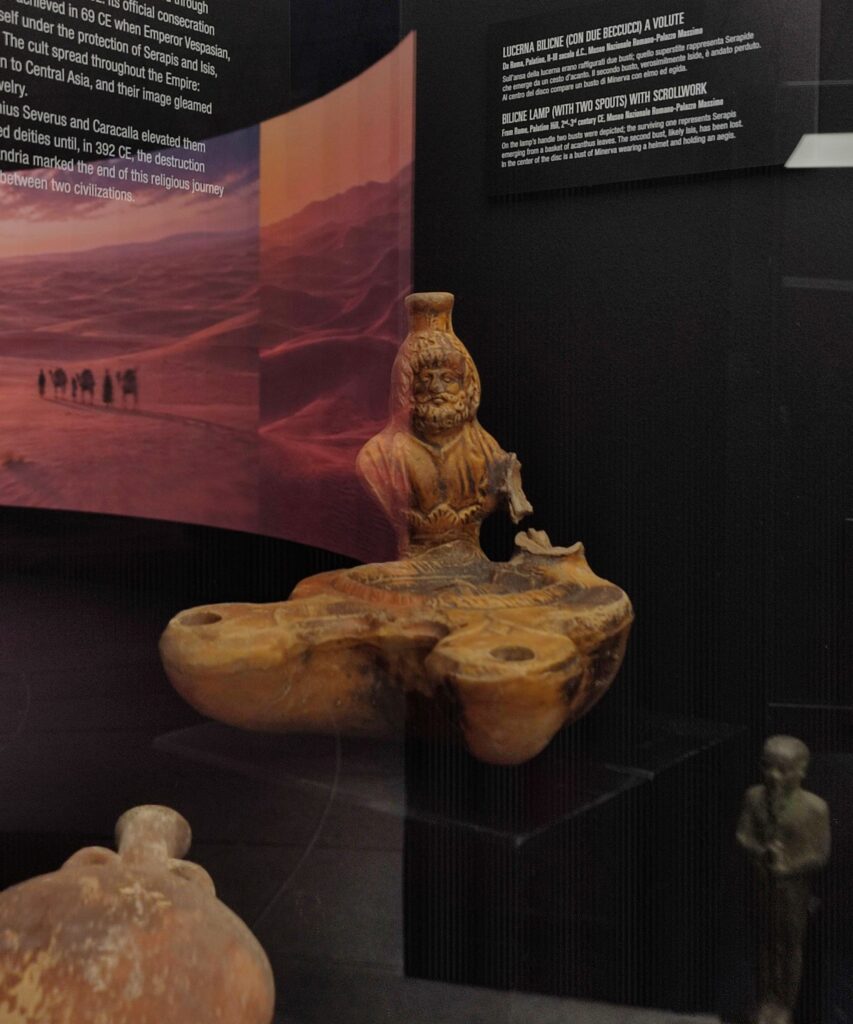
Accanto ai numerosi reperti recuperati dal Comando Carabinieri per la Tutela del Patrimonio Culturale, “Aegyptus” espone una importante selezione di reperti provenienti dai depositi del Museo Nazionale Romano, dunque normalmente inaccessibili al pubblico, e dalla Raccolta Egizia esposta presso Palazzo Altemps, anch’esso, come le Terme di Diocleziano, parte della rete museale MNR. Tra questi, di particolare interesse appaiono una stele del II secolo d.C. contente una rarissima Iside Thermouthis, raffigurazione della dea in guisa di serpente donata dall’archeologo Carlo Anti, ed una serie di sculture raffiguranti il dio Serapide, divinità sincretica greco-egizia introdotta ad Alessandria d’Egitto all’inizio del III secolo a.C. da Tolomeo I Soter, generale di Alessandro Magno fondatore della dinastia Tolemaica. Solitamente rappresentato con le sembianze del dio greco Zeus (capelli ricci e barba folta) e un kalathos (un cesto per misurare il grano) posizionato sul capo, Serapide era il risultato della fusione di numerose divinità greche ed egizie ed era contemporaneamente identificato sia come toro sacrificale che come dio dell’universo e signore dell’oltretomba, della fertilità e del Sole. Il suo culto si diffuse rapidamente nel mondo ellenistico e in gran parte dell’Impero Romano, per poi confondersi nel Cristianesimo.


La figura della dea Iside, questa volta rappresentata come Iside Fortuna reggente una cornucopia, ritorna all’interno di un gruppo statuario proveniente da Villa Grandi, dove fu rinvenuto in parte nel corso di scavi effettuati presso Porta Latina (Roma) nel 1937 durante lavori agricoli e in parte nel 1945 durante ricerche archeologiche condotte dalla locale Soprintendenza. Il sito venne successivamente identificato nella domus degli Aradii, una facoltosa famiglia di origini africane i cui membri rivestirono importanti ruoli politici nella Roma del III e IV secolo d.C.

In quello che appare un simbolico passaggio di consegne nell’esaltazione dei fasti della presenza romana nell’antico Egitto, fotogrammi della video opera “Aegyptus” mostrano al visitatore alcuni spettacolari ritratti provenienti dalle tombe del Fayum. La fiaccola del profondo legame che unisce Roma e l’Egitto passa adesso al Museo dell’Ara Pacis con la mostra “Il potere del ritratto. Egitto e Roma. I volti del Fayum”, Roma, dal 5 novembre 2026 al 2 maggio 2027.
testo e fotografie (dove non diversamente specificato) di Mirta Aktaia Fava

Ti ringraziamo per aver letto questo articolo. Se desideri restare aggiornato ti invitiamo a iscriverti alla newsletter cliccando qui
—————————————————————————————————————————–
ENGLISH VERSION
Aegyptus: Rome, Ancient Egypt and the Carabinieri for the Protection of Cultural Heritage
The deep ties linking Rome to Ancient Egypt have a complex millenary history, initiated during the Ptolemaic era and witnessed by the numerous obelisks still present in the Eternal City. The first diplomatic relations were established in 273 B.C., when a treaty of friendship between the Roman Republic and pharaoh Ptolemy II Philadelphus – second king of the Macedonian Greek dynasty founded by Alexander the Great’s general Ptolemy I Soter in 305 B.C. and extinguished with the death of Cleopatra VII – paved the way to the future Roman influence on the Kingdom. The initial diplomacy between equals slowly developed, across two centuries, into an informal Roman protectorate, culminated in the annexation of Egypt following the defeat of Mark Antony and Cleopatra by Octavian in the Battle of Actium and the suicide of the Egyptian queen. As a result of the division of the Roman Empire enacted after the death of Constantine the Great, the country became part of the Eastern Roman Empire and, subsequently, of the Byzantine Empire until the Arab conquest of 641 A.D.
Inagurated on 3 July 2026 and open to the public until 15 November at the Aula Ottagona delle Terme di Diocleziano, National Roman Museum, Rome, the exhibition “Aegyptus – From the Nile to the Mediterranean. Oases and the Desert During the Roman Era” narrates a period of Egyptian history that is largely unknown to the general public. The project, conceived by Elisabetta Bruscolini and curated by Alfonsina Russo, Angelo Piero Cappello, Federica Rinaldi and Alessio De Cristofaro in the framework of the cultural cooperation activities between Italy, Africa and the Mediterranean, covers the period that goes from the conquest of Egypt by Octavian to the rise of Christianity and of the Coptic culture.
The multimedia exhibition is organised in three different subject areas that merge archaeology, videoart and artificial intelligence: objects from the National Roman Museum, objects recovered by the Carabinieri for the Protection of Cultural Heritage (the “Carabinieri TPC”, also known as the “Carabinieri Art Squad” or the “Art Police”), and films dedicated to the influence exercised by the Romans in the form of engineering works, such as fortresses or aqueducts, aimed at facilitating caravan routes and therefore commercial exchanges. A Roman Egypt illustrated by objects and images that witness a compenetration between the two cultures destined to last for a long time.
The exhibition revolves around a futuristic installation, conceived as a spiral and designed by VPS Architetti, which occupies the entire Aula Ottagona delle Terme di Diocleziano. The installation pairs a traditional display section with a multimedia area enclosed within a curved screen of enormous proportions; here, videoart by Studio Covertino and a film created by Riccardo Bozzi with the use of artificial intelligence envelop visitors in an immersive experience. Also known as the “Museum of Saved Art”, the Aula Ottagona hosts, in rotation, objects and artworks recovered by the Italian state in Italy and abroad through the relentless activity of the Carabinieri for the Protection of Cultural Heritage. The first police force in the world specialised in cultural heritage protection, the Carabinieri Art Squad were established as a unit on 3 July 1969 by the then interim Chief of Staff General Armando Ferrara under the name Nucleo Tutela Patrimonio Artistico. The initiative anticipated, by about a year, the recommendation issued by the 1970 UNESCO Conference regarding the institution, within each member state, of police forces specialised in the fight against the illicit trafficking of cultural goods.
On 20 September 1971 the status of the unit was upgraded to that of a Command led by a Colonel and the pre-existing entity was subsequently reorganised as an operative unit. On 5 March 1992, a Decree issued by the Minister for Cultural and Environmental Property formally incorporated the Command within the Ministry and renamed it Comando Carabinieri per la Tutela del Patrimonio Artistico. This name would be maintained until 2001, when the Command assumed its current name Carabinieri per la Tutela del Patrimonio Culturale. A considerable number of Egyptian objects recovered by the Carabinieri Art Squad are on display within the exhibition: bas-reliefs, statues, textiles, amulets and artefacts of various nature, including those of apparent modern production, all obtained through seizures or voluntary returns in Italy and abroad. Among the most important recoveries: a cinerary urn in Egyptian alabaster, two marvellous fragments of basalt statues from the Metropolitan Museum of Art, New York (“the Met”), a pre-dynastic theriomorphic cosmetics tablet, and an amulet in the shape of a stele depicting Horus the Child.
Dating back to the I Century A.D. and illegally removed from a sepulchral site in Sassone-Castellano, near Rome, around the end of the 1970s, the cinerary urn, known as the “Ciampino Urn”, was seized in 2021 following its appearance in the antiques market and a tip from an auction house that alerted police. After its seizure, a joint intervention of the Carabinieri TPC and the Soprintendenza Archeologia Belle Arti e Paesaggio for the metropolitan area of Rome and the province of Rieti found, on site, the missing base of the elongated and narrow-shaped urn, of which only nine known examples exist. Magnificent are the basalt torsos of kings from the Metropolitan Museum of Art of New York, repatriated to Italy in 2025 along with other twelve archaeological finds following a reassessment of their provenance in the framework of the Museum’s recent “Cultural Property Initiative”. The two statues, deemed to be “likely made in Egypt and then brought to Italy during the Roman occupation of Egypt”, had doubtful provenance: purchased by the Met from American art dealer Peter Sharrer in 1981, they were previously property of disgraced British antiquities dealer Robin Symes and of art and antiquities trafficker Giacomo Medici.
Among the recoveries on display in the Aegyptus exhibition is a predynastic theriomorphic (bird-shaped) cosmetics tablet dating back to the Second Naqada Era (circa 3,700-3,400 B.C.), seized by the Carabinieri TPC in September 2022 during the operation “Pandora VII”. The operation was one of the first interventions based on the then new crime of illicit import of cultural goods (art.518 decies of the Italian penal code), introduced in Italy by Law n.22 of 9 March 2022 in line with EU Regulation 880/2019 and the Nicosia Convention. Hypnotic is the small basalt amulet known as “Stele of Horus on Crocodiles”, dating back to the Late Egyptian Period (378 B.C., XXX Dynasty) and depicting Horus the Child immersed in apotropaic symbolism associated with danger: the young god holds snakes and scorpions in both his hands while walking on crocodiles; behind him, a mask of god Bes, flanked on the right by the god of war and hunting Onuris and, on the left, by healing goddess Selkis. Emerged in the late 1970s during archaeological excavations in the Calabrian city of Kroton, formerly a region of Magna Graecia, and later vanished, the stele was seized by the Carabinieri TPC from the Museum of the Sforzesco Castle, Milan, in 2011 and restituted to its city of origin in 2012. Essential to its discovery at the Milanese museum, where it was on display as an object with unknown provenance within the Civic Egyptian Collection, was the investigation conducted by Architect Tommaso Tedesco, then honorary inspector of the Calabrian Soprintendenza. The Stele of Horus is on display at the Kroton National Archaeological Museum with inventory number 7816/M.
Testament to the variety of objects recovered by the Carabinieri Art Squad is the existence, within the “Aegyptus” exhibition, of an interesting section dedicated to modern forgeries and fakes. Among these, a superb female bust whose anomalous facial features, sculpting technique and type of stone appear to indicate a relatively recent production, and a bas-relief depicting monotheist pharaoh Akhenaten inspired by a stele held at the Neues Museum, Berlin. Along with the numerous archaeological finds recovered by the Carabinieri for the Protection of Cultural Heritage, “Aegyptus” exhibits an important selection of objects from the deposits of the National Roman Museum, therefore normally inaccessible to the public, and from the Egyptian Collection displayed at Palazzo Altemps. The latter is, like the Terme di Diocleziano, part of the MNR museum network. Among these objects, of particular interest are a II Century B.C. stele containing an extremely rare Isis Thermouthis, a representation of the goddess as a snake gifted by archaeologist Carlo Anti, and a series of sculptures depicting Serapis, a syncretic Greek-Egyptian deity introduced in Alexandria at the beginning of the III Century B.C. by Ptolemy I Soter, general of Alexander the Great and founder of the Ptolemaic dynasty. Largely depicted as resembling Greek god Zeus (curly hair, thick beard) and with a kalathos (a basket to measure wheat) on his head, Serapis was the result of the merger of several Greek and Egyptian deities and was identified at the same time as a sacrificial bull, master of the universe and god of the afterlife, fertility and the Sun. His cult spread rapidly across the Hellenistic world and most of the Roman Empire, finally merging with Christianity.
The image of goddess Isis, this time represented as Isis Fortuna holding a cornucopia, returns within a statuary group originating from Villa Grandi, where it was found in part during agricultural works conducted near Porta Latina in 1937, and in part during archaeological excavations performed by the local Soprintendenza in 1945. The site was later identified with the domus of the Aradii, a wealthy family of African origin the members of which held important political roles in Rome in the III and IV Centuries A.D.
In what appears to be a symbolic handover in honouring the splendour of the Roman presence in ancient Egypt, images from the video “Aegyptus” show visitors spectacular mummy portraits from Fayum. The torch celebrating the deep ties that unite Rome and Egypt now passes to the Ara Pacis Museum, with the exhibition “The Power of Portrait. Egypt and Rome. Faces from Fayum”, Rome, from 5 November 2026 to 2 May 2027.
Mirta Aktaia Fava
